What is the say-do gap?
The say-do gap is the distance between what consumers report in surveys, panels and focus groups and what they actually do with a product in their own home. People are not being dishonest. A survey simply asks them to predict their own behavior, and prediction is unreliable once a real kitchen, a real evening and a real price are involved. Peer-reviewed estimates put new food product failure at 50–75% within two years, and industry panels put it as high as 85%; decisions taken on stated intent are a large part of why. Eatpol closes the gap by recording what people really do with your product at home, so a go/no-go rests on observed behavior rather than stated intent.
How is privacy handled?
Faces are auto-masked in videos; we store de-identified signals only and comply with GDPR. All personal identifiers are removed from video footage, and test data is encrypted at rest. We provide a Data Processing Agreement (DPA) on request for enterprise clients. Testing participants can request deletion of their data at any time per GDPR Article 17 right-to-be-forgotten requirements. Our infrastructure meets international data protection standards.
Do we need special hardware?
No special hardware is required. Testers use their own smartphones (iOS or Android). We provide simple setup guidance directly inside the Eatpol app, and technical support is available throughout the test. The app is optimized for battery efficiency and does not require high-end devices. Any modern smartphone works. Most testers report setup takes fewer than 5 minutes.
How fast are results?
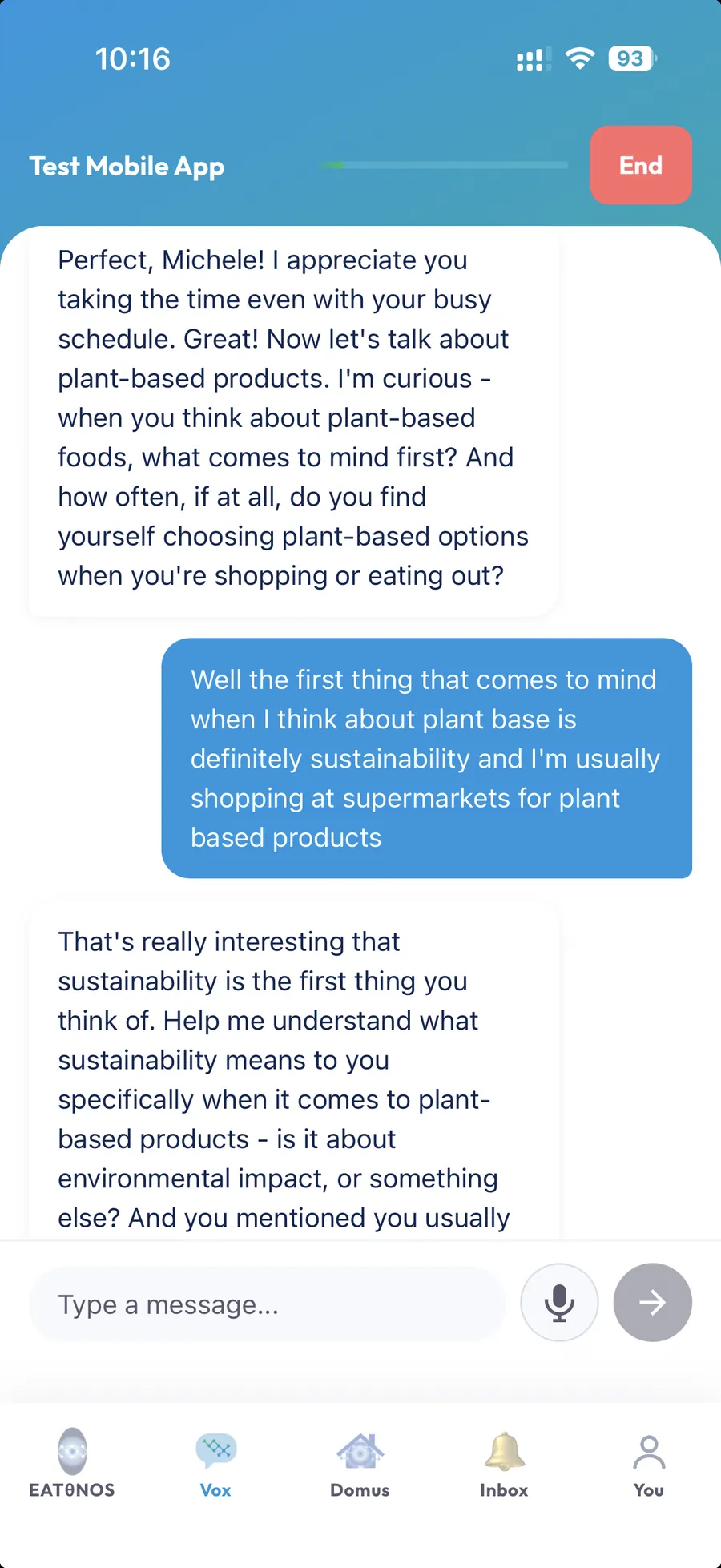
From kickoff to results in one week on average. Consumer interviews (Vox) and in-home product testing (Domus) run in parallel with recruitment. Results appear in your Eatpol Studio dashboard as soon as testing concludes, with AI-powered analysis and actionable insights ready for review.
Can we compare against competitors?
Yes, absolutely. You can include one or multiple competitor SKUs in your consumer test. We report relative performance metrics (purchase intent, emotional response, friction points) and identify key drivers of preference. Competitive benchmarking is useful for understanding market positioning and identifying product improvement opportunities relative to existing solutions in your category.
What if samples require cooking?
We capture all preparation and cooking steps as part of the test methodology. This allows us to connect consumer outcomes (satisfaction, purchase intent, friction) with real-world usage patterns. Our AI analyzes behavior during preparation (ease of use, time investment, any complications) and connects it to final product evaluation. This realistic context significantly improves predictive accuracy compared to pre-prepared samples in lab settings.